Showing posts with label Federal Reserve Actions. Show all posts

Saturday, September 16, 2006

Debt Shows First Drop as Slump Squeezes Consumers

At first glance, this seems like good news - Americans are actually reducing their debt. In a sane world with a sane monetary system – it would be. The problem – as we’ve discussed many times – is that debt creation is required in our current monetary system. We must continue to create debt each year equal to the aggregate rate of interest on all outstanding debts (as Chris mentions below) – or serious problems will begin rippling throughout the system – which we see happening everyday now. The debt required each year is now a very big number – and it’s getting bigger. So, when we see that debt is actually being reduced, it’s a very bad thing for a debt-based monetary system. This is the opposite of what we’d expect. We would like to think that paying off our debts would be a good thing – but it’s not a good thing in this system. The Federal Reserve obviously knows this – which is why we see them ‘injecting’ more and more money into the system by various means. Someone must pickup the slack in debt creation – it is required for the system to function.

This illustrates just how backwards our nation and the world has become. While God warns against becoming indebted to a lender, the world rewards us for taking on more debt. The reason? Because someday your debts are going to come due – and when you can’t pay – what you have will be taken from you – just as the Bible tells us. So, we are living in a monetary/economic system that rewards us for choosing the world’s ways over God’s ways – even though this will eventually lead to economic ruin. Surprised? You shouldn’t be. When we follow the world instead of God – this is the type of deception that we should expect.

Satan is the source of all deception and opposes God and His ways – on everything. Never forget – our spiritual enemy does not have a 75 year time horizon. He instituted systems within the world years ago that will allow him to gain worldwide control – over generations. How did he deceive us this long? We have focused on the here and now – on our wealth and power – and we have been blinded to the long term effects of what this will do to us. We have been tempted – and have given ourselves over to these temptations.

I have heard many Economists and ‘experts’ say that the current economic problems in the world today (U.S. negative account balance, world’s debt levels, etc.) cannot be sustained forever – and will need to be corrected at some point ‘in the future’. It’s much easier to push the hard choices into the future instead of seeking solutions today. We see this behavior inherent in our leaders – there has been no fiscal responsibility – and there still isn’t. In fact, it’s getting much worse with all of the ‘bailouts’ and ‘stimulus’ packages. Each generation has passed the problem on to the next – and as this problem has been passed – it has gotten worse with every subsequent generation. Now – our generation stands at the brink of the abyss. Now – our generation cannot simply pass along the problem because the system is collapsing. We – you and me – must now face the music for all of the sins of past generations.

We have been given the responsibility to find a way out of this mess. Can we do it alone? Can we take on the world and it’s deception by ourselves and somehow find a way to succeed against what appears to be insurmountable odds? We need to somehow find a monetary system that does not rely on exponential growth – that is stable and sustainable. At the same time, we must outsmart an evil spiritual being that will do everything possible to prevent our success. He will bring those he controls in the world against us at every turn. So, can we do all of this on our own? Not a chance. We only need to look at past generations and the decisions they have made to see the answer is no. Follow worldly intelligence and logic – and we will fail. I’m sure that there will seem to be many possible solutions – and all but one will lead to our destruction. There is only one way for us to succeed – God’s way.

jg – Dec 12, 2008
________________________________
Households pay down debts for first time

Thursday, December 11, 2008, 4:03 pm, by cmartenson
Chris Martenson

Mayday! Mayday!

This next story outlines a dire condition for a debt-based monetary system:


WASHINGTON (MarketWatch) - Stung by the loss of $2.81 trillion in their net wealth, U.S. households paid down their debts in the third quarter for the first time since at least 1952, the Federal Reserve reported Thursday.

As of Sept. 30, households' total outstanding debt shrank at an annual rate of 0.8% from $13.94 trillion to $13.91 trillion, the Fed said in its quarterly flow of funds report. It's the first decline in household debt ever recorded in the report.

Consumer debt actually reversed. This strange behavior has never before been observed in this data series and it goes back to 1952.

Whether we use an "outside-in" empirical approach to observe that debt and money have been created in exponential amounts over the past six decades, or an "inside-out" approach to demonstrate a mathematical requirement for the exponential creation of money/debt, we come to the same conclusion: We live in an exponential money system.

For this reason, the failure of consumer debt to expand at the required rate is very big news. What's "the required rate"? Roughly the aggregate rate of interest on all outstanding debts.
It seems that the hit came from the first ever recorded drop in mortgage debt:

Households paid off more mortgage debt than they took on for the first time on record. Mortgage debt fell at a 2.4% annual rate to $10.54 trillion. Other consumer debts, such as credit cards and auto loans, increased at a 1.2% annual rate in the quarter to $2.6 trillion.

I am not certain if the mortgages were paid down or defaulted upon, but the article implies that they were paid down. I am less sure of that given the massive foreclosure rates that are plastered all over the news.

Given that consumers are not pulling their weight, how is the system being held together? Readers of the last two Martenson Reports will not be surprised by the answer:

Total U.S. domestic nonfinancial debt increased at a 7.2% annual rate, boosted by a postwar record 39.2% increase in debt taken on by the federal government.

You can try and understand all the confusing alphabet soup lending facilities offered by the Fed, and try to track details of all the new borrowing by the government, but it is all really very simple to understand if we back up a bit.

New borrowing and lending is being undertaken by the Fed-government axis at a rate sufficient to equal all the outstanding interest payments on prior debts.

Without this new money creation defaults by somebody somewhere in the system is guaranteed.
Compounding the difficulties of the monetary and fiscal authorities is the fact that debts are already defaulting at a horrific clip.

All in all this leads me to conclude that when it comes to borrowing and new money creation, we haven't seen anything yet.

And still, even in the face of overwhelming evidence that there is an illness that lurks within the very design of the money system itself, there is precious little commentary on that subject in main stream media or the dominant political parties.

It's time to change that.
_____________________________
DECEMBER 12, 2008

Debt Shows First Drop as Slump Squeezes Consumers

Wall St. Journal

The U.S. economy is deteriorating more rapidly than expected just weeks ago, indicating the recession will be deeper and longer than feared as households and businesses struggle with the most stress they have faced in decades.

New Federal Reserve data revealed that U.S. households paid down debt for the first time since the central bank started collecting the information in 1952. While a positive longer-term trend, the higher savings rate means that consumers are spending less. That is a punishing turn for an economy in which consumer spending accounts for 70% of gross domestic product.

The Commerce Department said exports, which had helped sustain the economy through midyear, fell 2.2% in October from a month earlier as foreign demand for U.S. goods continued to fall. The nation's trade deficit rose in October to $57.2 billion from $56.6 billion in September, despite a considerable drop in oil prices during the month.

WSJ's Phil Izzo talks with Kelsey Hubbard about the results of the latest survey showing economists believe the current recession will last into June 2009, making it the longest since the Great Depression.

Another government report indicated that initial unemployment claims in the first week of December surged 58,000 from a week earlier to 573,000, a 26-year high, as companies slash payrolls before the end of the year. The number of workers continuing to collect jobless benefits jumped 338,000 to 4.43 million in the week ending Nov. 29 from the prior week -- matching the largest weekly increase on record, in November 1974 -- with little relief in sight as businesses brace for a lengthy downturn.

The government data spurred forecasters to update their expectations for the depth of the contraction, which is now expected to continue through the first half of next year. The increasingly grim news is likely to give a push to President-elect Barack Obama's plans for massive government spending to jolt the economy.

Citing the weak trade figures and other signs of a business slowdown, the forecasting firm Macroeconomic Advisers downgraded its estimate of GDP in the current quarter by a full percentage point on Thursday, to a 6.6% annualized decline. If that comes to pass, the quarter would rival the two worst periods in the recessions of the early 1980s. The economy declined by 7.8% in the second quarter of 1980 and 6.4% in the first quarter of 1982.

The final GDP number could turn out to be less dire, of course. Some economic consulting firms continue to estimate a slightly smaller 5% GDP decline this quarter followed by a 4% contraction in the first three months of next year.

Economists in the latest Wall Street Journal forecasting survey projected, on average, that the decline in GDP, which started in July, would continue through the first two quarters of 2009. If those predictions bear out, it would mark the first time GDP has contracted in four consecutive quarters during the postwar period.

On average, economists expect June 2009 to mark the end of the recession, which began in December 2007. That would put the downturn at 18 months, the longest period of decline since the Great Depression. The recessions of 1973-75 and 1981-82 each lasted 16 months.

The 54 economists in the latest Wall Street Journal survey predicted, on average, that GDP would contract at an annual rate of 4.3% in the fourth quarter of 2008, and 2.5% and 0.5% in the first two quarters of 2009. The Commerce Department's preliminary estimate showed a 0.5% decline in quarterly GDP for the third quarter of 2008. The economists were surveyed Dec. 5-8.
The expansion of the U.S. trade gap in October came as the plunging cost of oil imports was more than offset by a surge in the volume of oil that was imported. September's hurricanes, which disrupted activities at the port of Houston, partly caused the October import surge.

Exports of goods and services fell to $151.7 billion in October from $155.1 billion the prior month, as trading partners felt the effects of the worsening slowdown -- and a strengthening U.S. dollar. Total imports edged down to $208.9 billion from $211.6 billion, largely because of the drop in oil prices.

The broad-based decline in exports showed how a key engine of GDP growth earlier this year is sputtering. Trade represented as much as 2.9 percentage points of GDP growth in the second quarter, and 1.1 percentage points of growth in the third.

Through much of the first half of 2008, "the only thing that was keeping the economy from technically showing a reduction in GDP was trade," said IHS Global Insight economist Brian Bethune. "Even though we saw weak growth, it was strong enough to more or less keep factories busy and help absorb the shock of a weak domestic economy."

Now, "there's probably going to be little or no contribution from those exports," Mr. Bethune said.

The financial turmoil over the past year has taken a deep toll on consumers and businesses. The Federal Reserve said Thursday that U.S. household net worth fell 4.7% to $56.5 trillion in the third quarter, marking the fourth-straight quarterly decline, as home values, stocks and other assets lost value. Household net worth was down 11% from a year earlier.


The Fed's quarterly flow-of-funds report, the most comprehensive snapshot of the household sector available, showed that household debt contracted at a 0.8% rate, the first drop on record. Growth in consumer credit slowed to 1.2% at an annual rate in the July-September period, the Fed said, far lower than the 3.9% pace in the prior quarter. Borrowing for home mortgages fell at a 2.4% annual rate, the largest decline since the Fed began keeping the figure.

Consumers are being hit by falling home prices and job losses. The economists in the Journal survey on average said the unemployment rate will peak at 8.4% next year. While that rate was surpassed in both the 1970s and 1980s, it would mark a four-percentage-point increase from the low of 4.4% in March 2007. Only the 1973-75 recession, with a 4.1 percentage-point increase, had a larger jump in the postwar period.

Adding to consumers' pain: The end of the recession isn't likely to mark the end of job losses. In past recessions, labor-market contraction has continued for months after a downturn's official end. The economists surveyed, on average, forecast just an 8.1% rate for December 2009 as job cuts continue into 2010.

"The job market is ugly and is going to stay that way," said Allen Sinai at Decision Economics. "The economy is going through the heart of reductions in the work force now."

Many economists in the Wall Street Journal poll cited a major expected fiscal stimulus package as the key to pulling the U.S. out of recession, even though the structure of the package remains uncertain.

Write to Phil Izzo at philip.izzo@wsj.com, Brenda Cronin at brenda.cronin@wsj.com and Sudeep Reddy at sudeep.reddy@wsj.com

Fed Refuses to Disclose Recipients of $2 Trillion in Lending

Let’s think about a hypothetical situation for a moment. Let’s say that today it was announced that a privately owned bank – let’s call it the Federal Bank and Trust – was given authority to print the money of the United States Government and charge our government interest on this money for a period of 20 years. This bank would be given the authority to manage our money supply – by adjusting interest rates and the volume of money in circulation. It would be loosely regulated – but would exert immense power over not just our economy – but the world’s economy as well.

What if this fictitious bank then began to use it’s authority to wreak all kinds of havoc within our economy? What if it caused recessions and depressions due to its monetary policy, caused varying degrees of inflation which would systematically devalue the currency of the U.S. Government over time and repeatedly caused asset bubbles that were unsustainable – leading to crashes every few years? What if its monetary system required us to grow our money and economy exponentially – which would eventually lead us to economic collapse at the end of the 20 year period of time? What if this system enriched its private owners – while taking away the wealth of the citizens of the United States through foreclosures and loan defaults? What if this ‘Federal’ bank then began buying U.S. assets by printing money – but would not disclose the assets that were being purchased?

What do you think would happen today if our government made an announcement like this? I have a very good idea – outrage. Our political leaders would be inundated with phone calls and letters demanding that this be stopped. If our political leaders refused to stop it – there would be marches on Washington D.C. demanding the system be changed. Current political leaders would be replaced with leaders who would do what was in the best interests of the United States – regardless of what it might cost them. You and I would demand that this monetary system be changed to something else completely – because the U.S. Constitution is clear – government should be ruled by the people of the United States for the people – it should not be ruled by a small group of powerful interests.

All of the things mentioned above have been happening to us. One problem is that this new monetary system isn’t being announced today – it was announced in 1913. The other problem is that this scenario is not playing out over 20 years – it’s playing out over 100 years. Because this system was created in the U.S. in 1913 before most of us were born and because the owners of this bank have been patiently working behind the scenes for almost 100 years – we are blind to what is happening to us. We accept this system because – it’s the way it’s always been. We don’t know anything else.

The biggest problem of all is that the people behind this monetary system have now gained worldwide control. They not only control our financial system – they have infiltrated our governments. The obvious reason is this – banks do not exert this kind of power – unless it is given to them. Governments around the world gave Central Banks this power. The U.S. Government could at any time decide to rescind the Federal Reserve Act – kick out the Federal Reserve – and begin printing it’s own money – interest free. This has been the biggest fear of the powerful international banking cartel behind the world’s central banking system – which is why they have infiltrated our governments. You can play in the game all you want – just don’t threaten the game itself. It will take real leaders to overcome and remove this cancer that has grown within us.

It’s not hard to see what happens when someone in power opposes this beast – JFK was the most recent example of what happens when you threaten their game. He tried to do what I proposed above – kick out the Federal Reserve and give the U.S. government the power to print its own money. This cartel ended that little experiment within 6 months and sent a very loud message to anyone else who might get the same idea. When was the last time you heard a powerful political leader speak out against the Fed and their fiat currency? I have heard only one – Ron Paul – and it became clear that the mainstream media tried to reduce his exposure at every turn. I assure you – the cartel was watching his campaign closely.

If it doesn’t bother you that the Fed isn’t disclosing where it’s spending this money – it should – for a couple of reasons. The first being that they are not above the law – if they are using government money – the taxpayers have a right to know where it’s being spent and what our potential losses will be. The second reason is that we’re not talking about a small amount of money - $2 trillion is significant. A trillion here and a trillion there and pretty soon you’re talking about real money. The truth is that they do believe they are above the law and can do whatever they want. This would change if the American people ever stood up and demanded they account for their actions.

jg – Dec 15, 2008
__________________________
Fed Refuses to Disclose Recipients of $2 Trillion in Lending

Friday, December 12, 2008, 9:50 pm, by cmartenson

by: Chris Martenson

In a foxhole there are no atheists. But well before the praying begins, you find out what people are really made of. Perhaps the big, muscled kid who was unstoppable in basic training goes all to pieces while the skinny guy with the thick glasses saves everyone’s bacon. Or vice versa. The point being that prior to a crisis everything rests on appearances. During a crisis it is actions that matter. That’s when we find out what people, and institutions, are really made of.

Today the Federal Reserve effectively freaked out in the foxhole and declared the spirit of democracy, if not the rule of law, to be disposable conveniences of better times.

In response to a freedom of information act request by Bloomberg News for the names of the institutions receiving public money, the Fed invoked an obscure rule to block the release of this information.

Dec. 12 (Bloomberg) -- The Federal Reserve refused a request by Bloomberg News to disclose the recipients of more than $2 trillion of emergency loans from U.S. taxpayers and the assets the central bank is accepting as collateral.

Bloomberg filed suit Nov. 7 under the U.S. Freedom of Information Act requesting details about the terms of 11 Fed lending programs, most created during the deepest financial crisis since the Great Depression.

The Fed responded Dec. 8, saying it’s allowed to withhold internal memos as well as information about trade secrets and commercial information.

Trade secrets? A trade secret is something like the formula for Coke. A trade secret is an unpatented business process the release of which would harm the competitive position of the holder. I am really at a complete loss to understand what sort of “trade secrets” might apply to the acquisition of bad debt from poorly managed financial institutions.

If anybody can supply one that might make sense in this situation I am all ears.

The important principle here is that democracy cannot operate under the cover of darkness. If every emergency, no matter how slight, results in the immediate suspension of our right to know, then one might reasonably question whether it is a right at all and whether this is a democracy.

This is not an esoteric debate over some fine point of the law, this is a foundational matter. Either rules and laws matter or they don’t. Either they need to be followed by everybody or they can be ignored by everybody. There is no place in our legal system for each interested party to self-interpret laws in whatever manner fits them best.

If the Fed can unilaterally decide to follow some rules and not others, then why not anybody else? Would it be unreasonable for an individual to decide that their mortgage does not need to be repaid because they suddenly interpret their contract differently and to their benefit? Are they really “speed limits” or are they more like “speed guidelines?”

I am being quite serious here, the rule of law is not something to be trifled with. Either we are a nation of laws or we are not. It is no small point that our rule of law is one of the most essential components of our social contract and which separates us from other countries where I would not willingly choose to live.

The Freedom of Information Act requires federal agencies to make government documents available to the press and the public. The suit, filed in New York, doesn’t seek money damages.
“There has to be something they can tell the public because we have a right to know what they are doing,” said Lucy Dalglish, executive director of the Arlington, Virginia-based Reporters Committee for Freedom of the Press. “It would really be a shame if we have to find this out 10 years from now after some really nasty class-action suit and our financial system has completely collapsed.”

Did you catch those words and phrases? “Requires” and “right to know” are pretty straightforward. Requirements and rights are not really negotiable. They either exist or they don’t.

Predictably, the Fed claimed that this crisis is serious enough to trump our assumed (but rarely tested) right to know.

In its response to Bloomberg’s request, the Fed said the U.S. is facing “an unprecedented crisis” when the “loss in confidence in and between financial institutions can occur with lightning speed and devastating effects.”

But some are starting to catch on and noting that it is really not acceptable that a supposedly public institution is refusing to operate in a manner consistent with their charter.

“If they told us what they held, we would know the potential losses that the government may take and that’s what they don’t want us to know,” said Carlos Mendez, who oversees about $14 billion at New York-based ICP Capital LLC.

Congress is demanding more transparency from the Fed and Treasury on the bailout efforts, most recently during Dec. 10 hearings by the House Financial Services committee when Representative David Scott, a Georgia Democrat, said Americans had “been bamboozled.”
But now that the Fed has decided, unilaterally, to operate under the cover of secrecy I think they should be allowed to do so.

Of course I would also require that their operating charter be revoked and that a parallel currency be stood up so that we the people could decide for ourselves whether the Fed’s arguments for secrecy were worth risking our entire economic future upon.

Said another way, I am willing to let the Fed take all the primary risks it wants but not with my money. Let the Fed either swim or sink depending on how it plays its hand. Taxpayers should not be forced to shoulder whatever these risks are that the Fed feels are too dangerous to even name.

Otherwise people might begin to wonder about that “requirement” to pay back their credit card bills….

The Perils of Consumer Debt

I wrote in an earlier post on our monetary system (Part II) that debt levels are crushing the world’s economy - leading to deflationary pressures throughout the world. We’re seeing more and more articles like the one below that show how current household/corporate/government debt is approaching unmanageable levels. The same dynamic is at work here that is causing housing markets to collapse – debt levels are outpacing income around the world. As the ratio of total household debt to disposable income increases – consumers have less and less money to spend. This is causing the world’s economy to slow dramatically.

Let’s first take a look at household debts levels in the U.S. (South Korea household debt levels look very similar - graph shown in the article below).

It’s easy to see that our household debt to income ratio has grown exponentially over the past 30 years. This shouldn’t be surprising to us since our debt is growing exponentially – while our income is not. Let’s take a look at some information taken directly from the Fed. The following chart shows us our interest payments as a % of disposable income.

The chart above is showing us the percentage of our income required to meet our minimum debt payments (interest only). As you can see – since the early 1990’s – the minimum payment on our debt has risen steadily and now consumes over 14% of our income. Again – this is just to pay interest – this does not reflect payment of principal. If we add in principal – we see that Americans need almost $1 for every $5 earned to pay debt obligations.


Here’s the culprit (chart below). Household credit market debt outstanding has reached almost $15 trillion dollars in the U.S. What is happening today to the world’s economy is the result of some very simply math. We can only take on so much debt – before the amount of money required to service the debt – exceeds our ability to pay (income). If you are someone faced with paying the minimum on your credit card or buying groceries – what are you going to do? You’re going to buy groceries - of course. The same dynamic is playing out all over the world – current income cannot support existing debt plus living expenses (rent/mortgage, food, etc.) – so defaults are rising on credit cards, autos, mortgages, etc. People are prioritizing what they can afford – and buying additional ‘stuff’ is not high on the list – so the world’s economy is tanking. It doesn’t matter how much ‘liquidity’ is pumped into the world’s financial system – if consumers cannot take on any more debt – there is no lending. The other piece of the puzzle – as we’ve spent a great deal of time discussing in previous articles – is that debt growth isn’t simply good for the world’s economies – it’s required.


You’ll notice that household credit market debt outstanding seems to be leveling off on the chart above. You probably also noticed that the ratio of household debt service to income ratio (chart above) actually dropped last month. I posted an article a few weeks ago that explained how Americans actually reduced their outstanding debt in November – for the first time in our history. We are now beginning to realize that more debt is not good in this economic environment – and we see this phenomenon on these graphs. The graph below shows us the percentage change (Year/Year) of household credit market debt. As we’ve also discussed previously, consumer borrowing is falling off a cliff – and since exponential debt creation is required in this system – we’ve seen the Federal Reserve taking extraordinary actions to keep the system functioning.


This is not a problem isolated to the United States. Since every major economy is on the same system – we see that every nation is struggling with unmanageable debt loads.

External Debt (% of GDP)

The world doesn’t need more debt (as we’re constantly told by our leaders) – it needs a monetary system that is sustainable.

So, we are now in a situation where deflation (prices are dropping for everything) is rippling throughout the world’s economy due to crushing debt loads while the supply of money in the hands of consumers is also declining significantly. Since debt growth is slowing and debt equals money in our system– money supply growth is also slowing.


While the total supply of money continues to grow (albeit much slower over the past few months) – who is getting more of the money and who is getting less? Who is benefiting from the trillions in bailout money as the system collapses? The wealthy – bankers, Wall St., etc. Who continues to struggle under this system – you and me. Wealth is now being transferred from average people (that’s you and me again) to the rich at a dizzying pace.

It has always been this way – we just haven’t been paying attention. We live in a monetary system that allows (our Government allows this – which means you and I allow it) banks to create money and charge us interest on the money they create. Even though this fiat currency is inherently worthless, they continue to control more and more of the world’s assets through this system while you and I have less and less. I’ll say it again – this is not an accident.

Are the bailouts having any affect on the economy? Nope. Take a look at bank reserves at the Fed.


These excess reserves tell us that banks are not lending the money they are receiving – regardless of what we’re told through the media. This is due to the current state of the economy and the fact that the Fed is paying interest (.25%) on reserves.

How are credit markets? It appears that the Fed remains the lender of last resort.


Although we continue to hear lots of rhetoric about ‘reviving’ the economy - we are seeing economic conditions continue to deteriorate and we see the Fed and Treasury doing very little to help. The Fed lowered the Federal Funds Rate target to .25% yesterday – which simply matches the effective Federal Funds Rate – it’s actually been around .25% for months. Lots of talk – yet they are doing nothing to actually correct the situation. I don’t have to tell you again how this ends.

By the way – if you’ve heard the Fed talk about ‘Quantitative Easing’ and wondered what this means – it simply means that the Federal Reserve is planning to print vast amounts of dollars. If you’re thinking this could seriously devalue the dollar – you’re right.

jg – Dec 17, 2008
____________________________
DECEMBER 17, 2008
The Perils of Consumer Debt on Display in South Korea
By EVAN RAMSTAD
Wall St. Journal
SEOUL -- After the Asian financial crisis hit South Korea a decade ago, the government helped the export-dependent economy recover by pumping out money and convincing people to borrow and spend more.
But this time around, the high household debt that accumulated in the past decade is depressing spending -- an experience that has relevance around the world as governments seek ways to get consumers to help lift their economies.

A supermarket in Seoul, where debt is up and spending is down.
As exports drop and South Korea's economy slows, a high level of household debt is keeping consumers from spending more and the government -- like others elsewhere -- is wrestling with the question of how much to intervene.

South Korean lawmakers over the weekend approved a 2009 government budget that is 11.5% larger than this year's, at 284.5 trillion won ($208.65 billion). On Tuesday, the Ministry of Strategy and Finance unveiled a package of job programs and spending measures it calls the "South Korean New Deal."

The debate in South Korea is also colored by its unfinished rise from poverty, which began in the 1960s and proceeded strongly until the Asian crisis. In the aftermath, South Korean companies wiped out debt, built up cash and invested less in the economy, while the government eased consumer borrowing.

That led to a steep rise in consumer debt. Now, as the global slowdown erodes South Korea's ability to export goods, domestic consumption is too weak to drive economic activity the way it did in the late 1990s. The government expects private consumption to grow just 1% next year.
"Everybody is too much in debt, so they cannot consume," says Kim Kyeong-won, a senior vice president at Samsung Economic Research Institute.

According to data released by the Bank of Korea last week, South Korean household debt climbed 10.7% in the third quarter from the same period a year ago to a high of 676 trillion won. That amounts to 40 million won, or $29,300, per household.

South Korean government and banking officials acknowledge household debt levels are high but note that delinquency rates are low, and that falling interest rates are easing some of the pain. The central bank has lowered its main rate to 3% from 5.25% over the past two months.
Meanwhile, tight restrictions on mortgages -- consumers can only borrow up to 60% of the value of their property -- should insulate banks if defaults rise or property values fall.

The government's policies for 2009 are based on an expectation of 3% economic growth next year, said Noh Dae-lae, a deputy finance minister. That's higher than the Bank of Korea's forecast of 2%. Some private economists predict a contraction for the first time since 1998.

The consumer-debt problem is entering the debate over whether the South Korean government is too involved in the economy. President Lee Myung-bak campaigned last year on a platform of scaling back government involvement, including cutting regulation and privatizing some government companies. The prospect that Mr. Lee will instead preside over more intervention is widely debated in the parliament and media.

In South Korea's crisis a decade ago, the government propped up failing businesses and banks, and it remains a big shareholder of some of those firms today. And as consumer debt grew over the past five years, several new government programs emerged to help people avoid bankruptcy, which carries a social stigma.

At a credit-counseling center that is part of one such program, Yoon Sook-hyeon recently appealed for a new repayment schedule after an illness kept her from making six months of payments on a $27,000 debt-workout program she started three years ago. Ms. Yoon, a divorced mother of four, ran up the debt when she started putting expenses from her family business, a small motel in Seoul, on personal credit cards.

"When I started using a credit card, it was just for living costs, education fees and clothes for the kids," Ms. Yoon says. "When the business got worse, it was hard to pay the bills so I got cash from credit cards. Then it got more difficult, so I had to use several cards together. Later, I couldn't even do it." A credit counselor listened to her story for about 30 minutes and agreed to extend her program.

Jung Sook-cha and her husband have run up nearly $70,000 in education-related loans, which allowed one of their children to study overseas. She said she's worried her husband, who works at a bank, may be forced to take a pay cut in the slowing economy, hurting their ability to maintain loan payments of $1,000 a month.

—SungHa Park contributed to this article.
Write to Evan Ramstad at mailto:evan.ramstad@wsj.comm


The Grand Illusion - The Federal Reserve

You've probably wondered at some point after receiving these emails from me - is anyone else looking into this stuff besides Gilmore? Actually, there are many people who are now researching our monetary system - you just won't hear them on CNN or Fox News. It's very rare to hear anyone in mainstream media tell us the truth.

The article below was published recently and does a great job of briefly explaining the history of the Fed. If you haven't taken the time to research the Fed and our monetary system - now is the time to do so. This should be at the top of your list of priorities - it's that important. Why? Because sooner - rather than later - the Fed (and the world's central banking system) is going to lead us into the worst depression in the history of our nation. I hope this gets your attention - because it's the truth. You are watching it happen on the news everyday now.

If I were to point to one piece of information in the article below to focus on - it would be the following quote from the Rothschilds.

"Those few who can understand the system (check book money and credit) will either be so interested in its profits, or so dependent on it favors, that there will be little opposition from that class, while on the other hand, the great body of people mentally incapable of comprehending the tremendous advantage that capital derives from the system, will bear it burdens without complaint, and perhaps without even suspecting that the system is inimical to their interests." -Rothschild’s Bros. of London

What are they telling you? They are telling you that when it comes to this monetary system they created - there are two types of people in the world - and they are not worried about either of them. They are telling you that there are very few people who have the mental ability to understand the system. Are they worried about this minority? No. Why? Because this minority will be so enamored with the wealth and power that the system brings them - they will do nothing to stop it. They will ignore the danger it presents because their focus is on the money, power and prestige the system gives to them. Do you think this might apply to all of the intelligent people on Wall Street today? Even now - the vast majority of the people at the financial epicenter of the world - cannot see the danger.

The quote above also tells us that the Rothschilds believe the vast majority of us do not have the mental ability to understand the system - and therefore will be slaves to the system without knowing it. While most of us are burdened by the system without knowing it (struggling to earn enough to pay our bills, fighting to stay ahead of inflation, paying interest on everything, etc.), I believe that many people can understand the system once it's explained to them. It's actually a relatively simple system when you focus on the basics of how the system works - the problem is all of the deception surrounding it. You will not hear how our monetary system works on CNN, Fox News, CBS, NBC, ABC, etc. Our President is not going to inform you about the dangers of our monetary system during a primetime address. You will not find many (if any) college courses that accurately explain how the Federal Reserve System works. Did you study the history of the Fed at any point in high school? Did your high school economics teacher review the details of our monetary system with you? Did your high school economics text book have a chapter on our monetary system and how our money is created by debt? Did your high school math teacher use our money supply and debt as examples of exponential growth? You get the picture. There is a determined effort to keep the secrets of the system hidden.

Imagine what would happen tomorrow if someone was able to explain this system to every American. What would happen if every American woke up tomorrow morning and instead of watching 'Regis and Kelly' or 'American Idol' highlights - they instead watched a program explaining how the Fed is causing our economy and the financial system to collapse. What if their motives were exposed? What if every American began to ask some very hard questions like - why is our government allowing this to happen? The answers would lead to a very angry population. Ladies and gentlemen, this is the stuff of revolutions. I wish that none of this were true - but the truth is the truth. You either accept it and do something about it - or you do what most people in our nation are doing - and keep your head in the sand. Each of us chooses the path we will take. Each of us chooses who we will follow. Each of us chooses whether to take a stand against evil or succumb to it.

If you've studied what God has to say about the pursuit of money and applied this knowledge to our monetary system - then you've probably got alarms going off in your mind. Our spiritual enemy is very skilled at offering short term gains that deliver long term misery and destruction. Some of us recognize these tactics within our lives and protect ourselves accordingly. If you are a Christian - then you understand what I'm telling you. We are not unaware of the devil's schemes against us personally. The problem is that almost all of us never think about this from a corporate standpoint. Our nation has done a deal with our enemy - and I assure you - this deal will turn out like all the rest. We have experienced relatively short term gains - and now we're about to see the long term consequences.

Take Care,

John
March 12, 2009
_________________________________
The Grand Illusion – The Federal Reserve

The whole world is in a state of complete confusion. Americans are coming to the realization that their lives have been a grand illusion. You thought your neighbor had it made. They were driving a Mercedes, spent $40,000 on a new kitchen with granite countertops and stainless steel appliances, sent their kids to private school, had a second home at the shore, and took exotic vacations all over the world. Now their house is in foreclosure and you are paying to bail them out. The anger and outrage in the country is at the highest level since the Vietnam War. The American public is being misled by government officials, politicians, and the Federal Reserve regarding the causes of this crisis and the solutions needed to solve our economic tribulations.

The average American does not know much about the Federal Reserve. The government and the Federal Reserve prefer to operate in the shadows. If the American public understood what their policies have done to their lives, they would be rioting in the streets. Henry Ford had a similar opinion:

"It is well that the people of the nation do not understand our banking and monetary system, for if they did, I believe there would be a revolution before tomorrow morning."

Most Americans believe that the Federal Reserve is part of the government. They are wrong. It is a privately held corporation owned by stockholders. The Federal Reserve System is owned by the largest banks in the United States. There are Class A, B, and C shareholders. The owner banks and their shares in the Federal Reserve are a secret. Why is this a secret? It is likely that the biggest banks in the country are the major shareholders. Does this explain why Citicorp, Bank of America and JP Morgan, despite being insolvent, are being propped up by Ben Bernanke and Timothy Geithner?


The history of National Banks in the United States has been controversial since the Founding Fathers signed the Declaration of Independence. The Constitution of the United States unequivocally states that only Congress has the authority to coin money, not an independent bank owned by unknown bankers.

The Congress shall have Power to coin Money, regulate the Value thereof, and of foreign Coin, and fix the Standard of Weights and Measures

Article 1, Section 8 – US Constitution

Our most recent horrifying experience with an all powerful central bank has led to the current worldwide financial crisis. In less than one century the Federal Reserve Bank of the United States has destroyed our currency and has allowed bankers to gain unwarranted power over the country. They had the ability and opportunity to bring down the worldwide financial system.

When the average American is told that the dollar has lost 95% of its purchasing power since the inception of the Federal Reserve in 1913, they look at you with a blank stare and start wondering whether American Idol is on TV tonight. The systematic inflation purposely created by the Federal Reserve silently robs the average American of their standard of living. The CPI figures published by the US government tell the story.

Year
Annual Average (CPI)

1913
9.9

1914
10.0

1915
10.1
1916
10.9

1917
12.8

1918
15.1

1919
17.3

1920
20.0

1971
40.5

1972
41.8

1973
44.4

1974
49.3

1975
53.8

1976
56.9

1977
60.6

1978
65.2

1979
72.6

1980
82.4

1981
90.9

1982
96.5

2000
172.2

2001
177.0

2002
179.9

2003
184.0

2004
188.9

2005
195.3

2006
201.6

2007
207.3

2008
215.2

2009*
218.4

Source: BLS

The government began keeping official track of inflation in 1913, the year the Federal Reserve was created. The CPI on January 1, 1914 was 10.0. The CPI on January 1, 2009 was 211.1. This means that a man’s suit that cost $10 in 1913 would cost $211 today, a 2,111% increase in 96 years. This is a 95% loss in purchasing power of the dollar. For some further perspective here are the prices of some other common items in 1913 per the Morristown Daily Record:

Boy's shoes for school, .98/pair Women's shoes, 2.00-8.00/pair
Bread, .10/3 loaves Butter, fancy, .30/lb
Cereal, Kellogg's Corn Flakes, .09/box Eggs, Fresh Western, .27/dozen
Peanut butter, .09/jar Toilet paper, .26/6 rolls
Daily Record [Morristown NJ], .01/daily paper

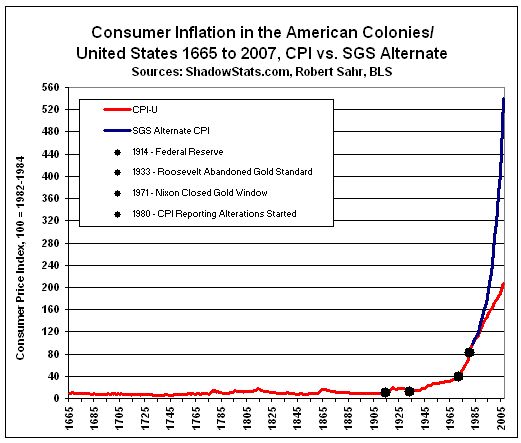
Notable on the CPI chart is that in the years following the creation of the Federal Reserve, inflation ran at double digit rates to finance Woodrow Wilson’s foreign intervention into World War I. The other notable period was in the years following President Nixon’s closing of the gold window in 1971. This led to rampant inflation that wasn’t tamed until the early 1980’s by Paul Volcker, the only independent courageous Federal Reserve Chairman in its history. The figures so far in the 21st Century seem modest. This is due partly to the methodical downward manipulation of the calculation by government bureaucrats. The period from 2010 to 2020 will show a dramatic jump caused by all of the money printing and reckless spending that is occurring today. Book it Dano.

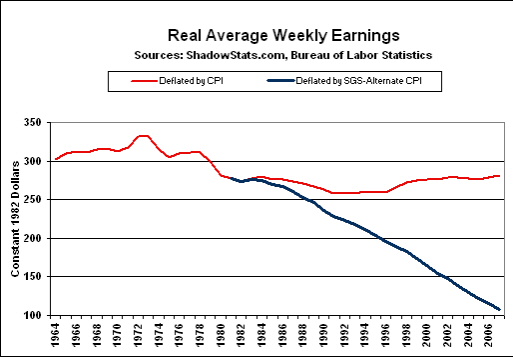
The average American might just conclude that prices always go up, so what’s the big deal about inflation. This is where the Federal Reserve and politicians have pulled the wool over your eyes. The CPI was 30.9 in 1964. Today, it is 211.1. This means that prices have risen 683% since 1964. The only problem is that your wages have not risen at the same rate, even using the government manipulated CPI. Using a true CPI figure, average weekly earnings are 64% below what they were in 1964. This explains why a family of five could live well with one parent working in 1964, but even with both parents working and using debt in prodigious amounts, the average family does not live as well today.


Don’t Know Much About History

The First Bank of the United States was created in 1791. Alexander Hamilton, the 1st Secretary of the Treasury, proposed this bank and convinced a hesitant President Washington to agree. John Adams and Thomas Jefferson were against the concept. It favored the moneyed classes of the North versus the agrarian South. The bank was given a 20 year charter and President James Madison let it expire in 1811. He then renewed the charter in 1816. The wise men who took unprecedented risks in declaring independence from England’s tyranny, feared the tyranny of bankers equally:

"All the perplexities, confusion and distress in America rise, not from defects in the Constitution or Confederation, not from want of honor or virtue, so much as from downright ignorance of the nature of coin, credit, and circulation."

John Adams, in a letter to Thomas Jefferson, 1787

"I believe that banking institutions are more dangerous to our liberties than standing armies. Already they have raised up a moneyed aristocracy that has set the government at defiance. The issuing power (of money) should be taken away from the banks and restored to the people to whom it properly belongs."

Thomas Jefferson, U.S. President -1802

[The] Bank of the United States... is one of the most deadly hostility existing, against the principles and form of our Constitution... An institution like this, penetrating by its branches every part of the Union, acting by command and in phalanx, may, in a critical moment, upset the government. I deem no government safe which is under the vassalage of any self-constituted authorities, or any other authority than that of the nation, or its regular functionaries. What an obstruction could not this bank of the United States, with all its branch banks, be in time of war! It might dictate to us the peace we should accept, or withdraw its aids. Ought we then to give further growth to an institution so powerful, so hostile?

Thomas Jefferson, U.S. President -1803

"History records that the money changers have used every form of abuse, intrigue, deceit, and violent means possible to maintain their control over governments by controlling money and its issuance".

James Madison, U.S. President

President Andrew Jackson was the first and only President in the history to pay off the National Debt. He worked tirelessly to rescind the charter of the Second Bank of the United States. His reasons for abolishing the bank were:
· It concentrated the nation's financial strength in a single institution.
· It exposed the government to control by foreign interests.
· It served mainly to make the rich richer.
· It exercised too much control over members of Congress.
· It favored northeastern states over southern and western states.

President Jackson believed that only Congress should be responsible for the issuance and control of the currency. Delegating that duty to powerful New York bankers was distasteful to him.

"If Congress has the right to issue paper money, it was given to them to be used ... and not to be delegated to individuals or corporations"

President Andrew Jackson, Vetoed Bank Bill of 1836

President Jackson, shown here "driving out the devils and money changers" with his order to withdraw public money from the central bank-Edward Clay lithograph, published 1833
President Jackson’s honesty and anger at the bankers should resonate today, as bankers have again brought our country to its knees.

“Gentlemen, I have had men watching you for a long time and I am convinced that you have used the funds of the bank to speculate in the breadstuffs of the country. When you won, you divided the profits amongst you, and when you lost, you charged it to the bank. You tell me that if I take the deposits from the bank and annul its charter, I shall ruin ten thousand families. That may be true, gentlemen, but that is your sin! Should I let you go on, you will ruin fifty thousand families, and that would be my sin! You are a den of vipers and thieves. I intend to rout you out, and by the grace of the Eternal God, will rout you out.”

A President with Jackson’s strength of character would put the blame where it belongs today. He would rout out these criminal bankers, rather than give them more taxpayer money to squander. A President with a moral backbone would put an end to the disastrous 96 year experiment of the Federal Reserve. Instead our last two spineless Presidents have put Goldman Sachs bankers in charge of our national Treasury. An examination of inflation throughout the history of the United States proves that from the beginning of our nation through wars and the Industrial Revolution, the country experienced virtually no inflation as our currency was backed by gold. The creation of the Federal Reserve in 1913 and the closing of the gold window in 1971 unleashed a tsunami of inflation that continues today.
Source: Chartingstocks.net

1913 – A Bad Year for America
Karl Marx published his Communist Manifesto in 1848. It included 10 planks. Two of the ten planks were as follows:
1. A heavy progressive or graduated income tax.
2. Centralization of credit in the hands of the State by means of a national bank with State capital and an exclusive monopoly.
The dates February 3, 1913 and December 24, 1913 framed a year which placed our country on a downward fiscal spiral. The United States had tinkered with an income tax during the Civil War and the 1890’s, but the Supreme Court declared it unconstitutional. Until 1913, the U.S. government was restrained from overspending because it was completely reliant on tariffs and duties to generate revenue. The Sixteenth Amendment changed the game forever.
“The Congress shall have power to lay and collect taxes on incomes, from whatever source derived, without apportionment among the several States, and without regard to any census or enumeration.”
When you give a Congressman a dollar, he’ll take a hundred billion. The initial tax rates of 1% to 7% were rather modest. That did not last long. The top tax rate reached 92% during the 1950s and today rates are still 500% to 1,000% higher than they were in 1913. The government is addicted to tax revenue. In 2007, they absconded $1.2 trillion in taxes from American individuals. Does anyone think that the bloated government bureaucracy spent these funds more efficiently or for a more beneficial purpose than its citizens could have?

Partial History of U.S. Federal Income Tax Rates Since 1913
ApplicableYear
Incomebrackets
Firstbracket
Topbracket
1913-1915
1%
7%
IRS
2003-2009
6 brackets
10%
35%
Tax Foundation
Source: Wikipedia

Without $1.2 trillion in individual tax revenue, Congressmen would not be able to add 9,200 earmarks to the current $400 billion Federal spending bill every year. This is how they waste your money:

· $1.8 million to research “swine odor and manure management” in Ames, Iowa.
· $41.5 million to upgrade presidential libraries of Franklin D. Roosevelt, Lyndon B. Johnson, and John F. Kennedy, according to the Heritage Foundation.
· $2.9 million to study how to breed and raise shrimp on “shrimp farms.” Citizens Against Government Waste (CAGW) reports that since 1985 the federal government has allocated $71 million to the study of shrimp science.
· $209,000 to improve blueberry production in Georgia, according to CAGW.
· $200,000 for a tattoo removal program in Mission Hills, Calif.
· $5.8 million for the Edward M. Kennedy Institute for the Senate in Boston, according to the Heritage Foundation.
· $6.6 million for Formosan subterranean termites, also according to Heritage.

Rothschild, J.P. Morgan & the Federal Reserve
"Those few who can understand the system (check book money and credit) will either be so interested in its profits, or so dependent on it favors, that there will be little opposition from that class, while on the other hand, the great body of people mentally incapable of comprehending the tremendous advantage that capital derives from the system, will bear it burdens without complaint, and perhaps without even suspecting that the system is inimical to their interests." -Rothschild’s Bros. of London
The House of Rothschild had been the dominant banking family in Europe for two centuries. They were known for making fortunes during Panics and War. Some claimed that they would cause Panics in order to take advantage of those who panicked. The Panic of 1907 was the used as the reason for creating the Federal Reserve. The Federal Reserve Bank of Minneapolis attributed the causes of the Panic of 1907 to financial manipulation from the existing banking establishment.
"If Knickerbocker Trust would falter, then Congress and the public would lose faith in all trust companies and banks would stand to gain, the bankers reasoned." -J.P. Morgan (1837-1913)

In 1906, Frank Vanderlip Vice President of the Rockefeller owned National City Bank convinced many of New York's banking establishment that they needed a banker-controlled central bank that could serve the nation's financial system. Up to that time, the House of Morgan had filled that role. JP Morgan had initiated previous panics in order to initiate stronger control over the banking system. (Picture slimy Mr. Potter offering the members of the Bailey Building & Loan, 50 cents on the dollar for their shares during a bank panic in the classic movie Its A Wonderful Life). Morgan initiated the Panic of 1907 by circulating rumors that the Knickerbocker Bank and Trust Co. of America was going broke, there was a run on the banks creating a financial crisis which began to solidify support for a central banking system. During this panic Paul Warburg, a Rothschild associate, wrote an essay called "A Plan for a Modified Central Bank" which called for a Central Bank in which 50% would be owned by the government and 50% by the nation's banks.
In November 1910 a secret conference took place on Jekyll Island off the coast of Georgia. Those in attendance were: JP Morgan, Paul Warburg, John D. Rockefeller, Bernard Baruch, Senator Nelson Aldrich, Colonel House, Frank Vanderlip, Benjamin Strong, Charles Norton, Jacob Schiff, and Henry Davison. Out of this meeting of the most powerful bankers and politicians in the country came the plan for a Central Bank. This conference was unknown until 1933. In 1935, Frank Vanderlip wrote in the Saturday Evening Post: "I do not feel it is any exaggeration to speak of our secret expedition to Jekyll Island as the occasion of the actual conception of what eventually became the Federal Reserve System."
Behind the scenes these powerful men were formulating the plan for a Federal Reserve System. There was no outcry from the public to implement this plan. The public knew nothing of this. The Aldrich Plan was renamed the Federal Reserve Act and pushed forward by Paul Warburg and Colonel House. Warburg essentially wrote the Act and pressured Congressmen to see his way or lose the next election. Colonel House, who had socialist leanings, was the top advisor to President Wilson.
The Glass Bill (the House version of the final Federal Reserve Act) had passed the House on September 18, 1913 by 287 to 85. On December 19, 1913, the Senate passed their version by a vote of 54-34. More than forty important differences in the House and Senate versions remained to be settled, and the opponents of the bill in both houses of Congress were led to believe that many weeks would elapse before the Conference bill would be taken up. The Congressmen prepared to leave Washington for the annual Christmas recess, assured that the Conference bill would not be brought up until the following year. The creators of the bill then pulled the ultimate scam on the American public. In a single day, they ironed out all forty of the disputed passages in the bill and quickly brought it to a vote. On Monday, December 22, 1913, the bill was passed by the House 282-60 and the Senate 43-23. This meant that the single most important piece of legislation ever passed by the Senate was missing the votes of 26 Senators because it was passed during the Christmas recess. President Wilson, at the urging of Bernard Baruch, signed the bill on December 23, 1913. A few years later, President Wilson had second thoughts:
"I am a most unhappy man. I have unwittingly ruined my country. A great industrial nation is controlled by its system of credit. Our system of credit is concentrated in the hands of a few men. We have come to be one of the worst ruled, one of the most completely controlled and dominated governments in the world--no longer a government of free opinion, no longer a government by conviction and vote of the majority, but a government by the opinion and duress of small groups of dominant men."
There were some brave Americans who did oppose this legislation and foresaw the devastation that it would lead to.
“Throughout my public life I have supported all measures designed to take the Government out of the banking business. This bill puts the Government into the banking business as never before in our history. The powers vested in the Federal Reserve Board seen to me highly dangerous especially where there is political control of the Board. I should be sorry to hold stock in a bank subject to such dominations. The bill as it stands seems to me to open the way to a vast inflation of the currency. I had hoped to support this bill, but I cannot vote for it cause it seems to me to contain features and to rest upon principles in the highest degree menacing to our prosperity, to stability in business, and to the general welfare of the people of the United States.”
Senator Henry Cabot Lodge – Dec 17, 1913
“From now on, depressions will be scientifically created.”
Congressman Charles A. Lindbergh Sr. - 1913
John Maynard Keynes, the current hero of the Obama administration and Paul Krugman, had this to say about the Federal Reserve in 1920.
“Should government refrain from regulation (taxation), the worthlessness of the money become apparent and the fraud can no longer be concealed. By this means government may secretly and unobserved, confiscate the wealth of the people and not one man in a million will detect the theft."
Mandate from Hell
According to the Federal Reserve’s own website, their duties fall into four general areas:
Conducting the nation's monetary policy by influencing the monetary and credit conditions in the economy in pursuit of maximum employment, stable prices, and moderate long-term interest rates.
Supervising and regulating banking institutions to ensure the safety and soundness of the nation's banking and financial system and to protect the credit rights of consumers
Maintaining the stability of the financial system and containing systemic risk that may arise in financial markets
Providing financial services to depository institutions, the U.S. government, and foreign official institutions, including playing a major role in operating the nation's payments system
The American public was told that the Federal Reserve would eliminate any future bank panics. From 1913 through 1920, inflation increased at more than 10% per year as Wilson spent vast sums during World War I and its aftermath. From the early 1920s to 1929, the monetary supply expanded at a rapid pace and the nation experienced tremendous economic growth. Benjamin Strong, one of the participants at the secret conference on Jekyll Island, was the Federal Reserve head. By the end of the 1920s, speculation and loose money had propelled asset and equity prices to unsustainable levels. The stock market crashed in 1929, and as the banks struggled with liquidity problems, the Federal Reserve cut the money supply. This was the greatest financial panic and economic collapse in American history so far - and it never could have happened without the Fed's intervention. The Fed caused the bubble with loose monetary policy. The Depression did not become Great until the Smoot Hawley Act in 1930 destroyed world trade and the raising of the top income tax rates from 25% to 63% in 1932 destroyed the incentive to earn money. Over 9,000 banks failed and a few of the old robber barons' banks managed to swoop in and grab up thousands of competitors for pennies on the dollar.
The Federal Reserve’s primary mandates were maximum employment, stable prices and moderate long-term interest rates. Their other chief function was to supervise and regulate banks to ensure the banking system is safe. Lets assess their success regarding their mandates:

Unemployment reached 25% during the Great Depression; attained levels above 10% in 1982; and will breach 10% in the next year. Grade: Failure

Based on the chart above and the CPI data since the Federal Reserve’s inception, the dollar has lost 95% of its purchasing power. Grade: Failure

Based on the chart below interest rates have been anything but moderate since the inception of the Federal Reserve. They have consistently caused booms and busts by setting rates too low or too high. Grade: Failure

The Federal Reserve was supposed to supervise the activities of banks. Instead, under Alan Greenspan, they stepped aside and let banks take preposterous risks while giving an unspoken assurance that the Fed would clean up any messes that they caused. This total dereliction of duty gross negligence has led the greatest financial collapse in history. Grade: Failure


Voices of Reason

The Chairman of the House banking & Currency Committee Louis T. McFadden fought a lonely battle against the Federal Reserve in the early 1930s. He was swept out of office when his opponent in the next election received thousands of dollars in campaign contributions.

"Mr. Chairman, we have in this Country one of the most corrupt institutions the world has ever known. I refer to the Federal Reserve Board and the Federal Reserve Banks, hereinafter called the Fed. The Fed has cheated the Government of these United States and the people of the United States out of enough money to pay the Nation's debt. The depredations and iniquities of the Fed have cost enough money to pay the National debt several times over. This evil institution has impoverished and ruined the people of these United States, has bankrupted itself, and has practically bankrupted our Government. It has done this through the defects of the law under which it operates, through the maladministration of that law by the Fed and through the corrupt practices of the moneyed vultures who control it.”

Louis T. McFadden – Representative from PA 1934

Mr. McFadden has a soul mate in Representative Ron Paul from Texas. Mr. Paul has been on a one man mission to abolish the Federal Reserve for over a decade. He seems to be the only person in Congress with the courage, fortitude and intellect to understand the damage that has been caused by the Federal Reserve and call for its abolition. The entrenched political class, despise Mr. Paul because his call to abolish the Federal Reserve would destroy their ill begotten wealth and power.

Since the creation of the Federal Reserve, middle and working-class Americans have been victimized by a boom-and-bust monetary policy. In addition, most Americans have suffered a steadily eroding purchasing power because of the Federal Reserve's inflationary policies. This represents a real, if hidden, tax imposed on the American people.

From the Great Depression, to the stagflation of the seventies, to the burst of the dotcom bubble last year, every economic downturn suffered by the country over the last 80 years can be traced to Federal Reserve policy. The Fed has followed a consistent policy of flooding the economy with easy money, leading to a misallocation of resources and an artificial "boom" followed by a recession or depression when the Fed-created bubble bursts. In conclusion, Mr. Speaker, I urge my colleagues to stand up for working Americans by putting an end to the manipulation of the money supply which erodes Americans' standard of living, enlarges big government, and enriches well-connected elites, by cosponsoring my legislation to abolish the Federal Reserve.
Ron Paul – Sept 10, 2002

Representative Paul sized up his colleagues in Congress and the Federal Reserve perfectly in 2006 when they were oblivious to the impending disaster that was about to befall the nation. He was belittled by the mainstream press and fellow Congressmen.

The coming dollar crisis is not likely to be “fixed” by politicians who are unwilling to make hard choices, admit mistakes, and spend less money. Demographic trends will place even greater demands on Congress to maintain benefits for millions of older Americans who are dependent on the federal government.

Faced with uncomfortable financial realities, Congress will seek to avoid the day of reckoning by the most expedient means available – and the Federal Reserve undoubtedly will accommodate Washington by printing more dollars to pay the bills. The Fed is the enabler for the spending addicts in Congress, who would rather spend new fiat money than face the political consequences of raising taxes or borrowing more abroad.

The irony is that many of the Fed’s biggest cheerleaders are the same supposed capitalists who denounced centralized economic planning when practiced by the former Soviet Union. Large banks and Wall Street firms love the Fed’s easy money policy, because they profit at the front end from the resulting loan boom and artificially high equity prices. It’s the little guy who loses when the inflated dollars finally trickle down to him and erode his buying power. Someday Americans will understand that Federal Reserve bankers have no magic ability – and certainly no legal or moral right – to decide how much money should exist and what the cost of borrowing money should be.

Ron Paul – July 11, 2006

Before he became a tool of the political ruling elite and the bankers who truly control the country, Alan Greenspan actually understood and supported a currency backed by gold which couldn’t be manipulated by corrupt politicians. The confiscation of middle class wealth through the insidious use of inflation has proceeded unchecked for 96 years.

In the absence of the gold standard, there is no way to protect savings from confiscation through inflation. There is no safe store of value. If there were, the government would have to make its holding illegal, as was done in the case of gold. If everyone decided, for example, to convert all his bank deposits to silver or copper or any other good, and thereafter declined to accept checks as payment for goods, bank deposits would lose their purchasing power and government-created bank credit would be worthless as a claim on goods. The financial policy of the welfare state requires that there be no way for the owners of wealth to protect themselves. This is the shabby secret of the welfare statists' tirades against gold. Deficit spending is simply a scheme for the confiscation of wealth. Gold stands in the way of this insidious process. It stands as a protector of property rights. If one grasps this, one has no difficulty in understanding the statists' antagonism toward the gold standard.

Alan Greenspan – 1966

I’m Mad as Hell & I’m Not Going to Take it Anymore

Howard Beale, the news anchor in the movie Network, could have spoken the same lines today that he was speaking in 1976. He describes our current financial crisis to a tee.

I don't have to tell you things are bad. Everybody knows things are bad. It's a depression. Everybody's out of work or scared of losing their job. The dollar buys a nickel's worth; banks are going bust; shopkeepers keep a gun under the counter; punks are running wild in the street, and there's nobody anywhere who seems to know what to do, and there's no end to it.

I want you to get mad!

I don't want you to protest. I don't want you to riot. I don't want you to write to your Congressman, because I wouldn't know what to tell you to write. I don't know what to do about the depression and the inflation and the Russians and the crime in the street.

All I know is that first, you've got to get mad.

You've gotta say, "I'm a human being, My life has value!"

So, I want you to get up now. I want all of you to get up out of your chairs. I want you to get up right now and go to the window, open it, and stick your head out and yell,

"I'm as mad as hell, and I'm not going to take this anymore!!"

Anyone who is not mad as hell at this point is not paying attention. Your tax and spend corrupted politician leaders and your banker controlled Federal Reserve have borrowed and spent your tax dollars, your children’s tax dollars, and their children’s tax dollars desperately attempting to prop up this bankrupt system. The unleashing of a never ending tsunami of printed dollars by the Federal Reserve makes every dollar worth less. They have systematically created inflation that has slowly but surely reduced your standard of living. Politicians in the pocket of lobbyists, corporate interests, and bankers have used their power to tax in order to spend trillions on worthless projects in their districts to insure re-election. The combination of taxing and printing has led to a National Debt of $11 trillion.


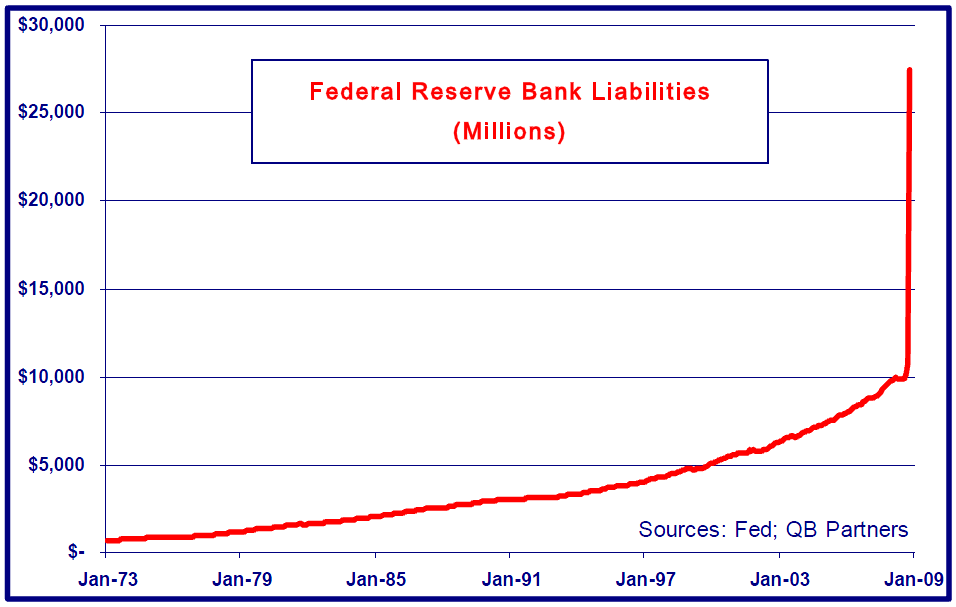
Bankers love debt. The more debt, the more interest they collect. Issuing credit cards and collecting 21% interest and billions in late fees seemed like a can’t miss proposition. It was until people couldn’t pay the debt back. Now the unwinding of the greatest debt bubble in history has created a 2nd Great Depression. Instead of learning from the past, the Federal Reserve has chosen to do exactly what led to the crisis. They have lowered rates to 0% and have printed money at prodigious rates. The Fed has doubled their balance sheet in the last 12 months.

They have loaned billions to the bankrupt banks that inhabit our financial system while accepting worthless pieces of paper as collateral. They have hailed back to Jekyll Island and the cloak of secrecy. They will not reveal to the public the banks they have loaned money to or the collateral that backs up those loans. The arrogance of Ben Bernanke proves that the Federal Reserve answers to bankers, and not to the American public. The books and records of the Federal Reserve are not open to scrutiny by the General Accounting Office. Ron Paul has introduced the Federal Reserve Transparency Act which would open their books to the public. No organization with as much power as the Federal Reserve should be permitted to operate in the shadows.

A recent article by David Galland from Casey Research pointed out the insidious methods by which the government extracts our money for their self serving schemes:

Accounts Receivable Tax Building Permit Tax
CDL License Tax Cigarette Tax
Corporate Income Tax Dog License Tax
Excise Tax Federal Income Tax
Federal Unemployment Tax (FUTA) Fishing License Tax
Food License Tax Fuel Permit Tax
Gasoline Tax Gross Receipts Tax
Hunting License Tax Inheritance Tax
Inventory Tax IRS Interest /IRS Penalties
Liquor Tax Luxury Taxes
Marriage License Tax Medicare Tax
Personal Property Tax Property Tax
Real Estate Tax Service Charge Tax
Social Security Tax Road Usage Tax
Sales Tax Recreational Vehicle Tax
School Tax State Income Tax
State Unemployment Tax (SUTA) Telephone Federal Excise Tax
Utility Taxes Vehicle Sales Tax
Watercraft Registration Tax Well Permit Tax
Telephone State and Local Tax Telephone Usage Charge Tax
Vehicle License Registration Tax Workers Compensation Tax.Telephone Federal Universal Service Fee Tax
Telephone Federal, State and Local Surcharge Taxes
Telephone Minimum Usage Surcharge Tax
Telephone Recurring and Non-recurring Charges Tax
After digesting this disgusting list, do you feel under taxed?
Depression, Collapse & Revival

The future is cloudy but the direction is clear. Government will spend trillions of dollars.


Congress will increase taxes on the rich and secretly raise taxes on the masses by calling them cap and trade fees. The Federal Reserve will pull out all stops to create inflation. When you owe the rest of the world $11 trillion, inflation makes the debt less burdensome. The dollar will decline versus gold. With the enormous amount of currency creation and spending by the government, the economy will eventually pull out of this depression. The acceleration will take the Federal Reserve by surprise. They will be hesitant to raise interest rates. The inflation genie will get out of the bottle and will not go back. The hyperinflation that takes hold will lead to social unrest, rioting, and a drastic reduction in the American standard of living.


There is no solution that will not be painful to everyone in the United States. The only solution that would put America back on a path of sustainable prosperity would be a gold/precious metals backed currency that would force government and its citizens to live within its means. Congress would need to vote for something that would take away its power. With our current political system, this is impossible. Money is power. This leads to only one conclusion. The existing Ponzi scheme will have to collapse before we can adopt a rational financial system for America. It may take decades, or it may happen in 2010. No one knows. If the country can be convinced to follow the wisdom of Ron Paul, we still have a chance to avoid this fate.

When the Federal government spends more each year than it collects in tax revenues, it has three choices: It can raise taxes, print money, or borrow money. While these actions may benefit politicians, all three options are bad for average Americans.

To discuss ways to take back our country from corrupt politicians and criminal bankers join me at TheBurningPlatform.com.

Fed in Bond-Buying Binge to Spur Growth

I mentioned a few months ago that we’ll enter a new phase of this crisis if/when the Fed begins buying U.S. Treasury Bonds (monetizing U.S. debt). That phase started yesterday when the Federal Reserve announced it would begin buying Treasurys and mortgage-backed securities. What does this mean? It means that the Fed will begin creating trillions of dollars to buy these securities – essentially flooding the system with dollars.

If there’s one thing we’ve learned over the past few months - when we’re given a number – in this case $1.5 trillion dollars (amount of securities to be bought by the Fed) – the actual number will be much bigger. $1.5 trillion is an astronomical number – but I believe it’s only the beginning.

What are the real world implications? If you own Treasurys and know you have a guaranteed buyer (creating artificial demand) – what affect would this have on prices? You would expect prices to increase – and that’s exactly what is happening. In the world of bonds – if prices increase (due to demand) – yields fall – since the owner of the bonds doesn’t need to offer as much interest to sell them – and we see yields falling for Treasurys across the board – which in turn, drives down interest rates for you and me.

There are other consequences. Everyone is anticipating an additional $1.5 trillion dollars in the system over the next few months. What affect would you expect this to have on the value of the dollar? Significantly more dollars in the system should result in a drop in the value of the dollar – and that’s exactly what we’re seeing. If everyone expects the value of their fiat currency to decrease – where does everyone invest to hedge against this loss of value? Gold. Gold prices increased 6% yesterday after the Fed announcement and are up another 8% today.

With trillions of additional dollars flooding the system – would you expect inflation to decrease or increase? You would expect inflation to increase significantly in the coming months with such an increase in dollars.

So – in the coming months, we should expect to see the following things happen:

1. The value of the dollar will decline – and the decline will be significant.
2. The value of gold will increase – and the increase will be significant.
3. There is a very strong possibility that Inflation will increase significantly – leading to a hyper-inflationary spiral – which will eventually destroy the value of the dollar - completely.
4. When the U.S. is unable to finance its growing budget deficits because the world will no longer purchase our debt (possibly leading to short-term Treasury auction purchases by the Fed) – interest rates will rise – and the rise will be significant.
5. The instability of the world’s financial system will continue – leading to a continuing decline in the world’s stock/bond/derivatives markets.
6. The housing market cannot ‘recover’ from this crisis in this environment – housing prices will continue to decline – and the decline will be significant.
7. We should expect more Central Bank ‘actions’ and more ‘stimulus’ packages from governments around the world – but these actions will only delay the inevitable collapse of the world’s debt-based monetary system.
8. Due to these issues – expect world leaders to eventually offer a final ‘solution’ to the crisis – a solution that will involve a new, heavily regulated, global monetary system.

I believe we’re in a relatively calm period (compared to our future) – before things begin to really head downhill. So – you need to consider the following now:

1. Due to the Fed actions mentioned above – interest rates are temporarily low. If you are in an adjustable rate mortgage of any kind – now is the time to refinance to a 30 year fixed rate – if you can. The current window of low interest rates is going to close very soon.
2. If you believe your home’s value is going to increase at some point in the near future - it’s not going to happen. Don’t think that your home’s future value is going to solve financial problems – it’s all downhill from here.
3. If you have stocks/bonds/derivatives in any type of portfolio – brokerage, 401(k), etc. – sell them. Very soon – they will not be worth the paper they’re printed on – and I believe these markets will decline much more rapidly than the value of the dollar. If you’re worried about penalties – don’t be. Better to pay a 10% penalty now than to keep letting it ride in the stock market. Just like Vegas - sooner or later – the house is going to win.
4. Buy gold if you can – coins, etc. It’s difficult to find at this point. If you can find some – buy it. As I mentioned above – when the world’s fiat currencies decline significantly – the world will move to gold as its default currency for a period of time – just as it always has. If you can’t buy physical gold – move your investments into a Gold ETF (Exchange Traded Fund).
5. Imagine a world where prime interest rates are 20+%. With U.S. budget deficits projected in the trillions in coming years - there is a very high probability of this happening – and soon. If you are considering purchases that require a loan – keep this in mind.
6. Keep more non-perishable food on hand than normal. Nothing crazy – just shop every few days – instead of once a week. If something catastrophic happens (stock market crash, etc.) and people begin to panic – you don’t want to be one of the many people who are going to open their pantry and see 2 cans of soup. You will want to be able to avoid a mad rush to the supermarket.
7. Keep in mind that taking these precautions will only help you short-term. When the system collapses – all bets are off. We’re going to go through some chaotic times. Mentally prepare yourself for seeing things in this country that you never expected to see. More importantly – as I’ve said many times – you must be prepared spiritually. Faith is required to stand against what’s coming.

I’m reiterating the points above because things are getting very serious. If the Federal Reserve feels it necessary to pump $1.5 trillion dollars into the system to keep it going – it’s serious. If the Federal Government finds it necessary to pump $800 billion dollars into the system – it’s serious. If the Fed and our Government see it necessary to keep ‘bailing out’ large banks and corporations with billions of dollars (AIG, Citigroup, etc.) to prevent a complete collapse of the system – it’s serious.

We’ve been lulled into believing that nothing catastrophic could happen to us because of the recent past. The past 30 years have absolutely no bearing on the next 30. I realize that I’m telling you to do the opposite of what most of our leaders are telling you – which is why I encourage you to research these things on your own.

I don’t like to bring bad news to good people – but I’ve studied this monetary system for over 3 ½ years and the things I spoke about in 2005 – are happening today. There is one and only one end to this system – be prepared for it.

jg – March 19, 2009
______________________________________________
MARCH 19, 2009

Fed in Bond-Buying Binge to Spur Growth

Dramatic Plan to Purchase $300 Billion in Treasurys Causes Biggest Drop in Interest Rates Since '87; Perils of Printing Money

Wall St. Journal

By JON HILSENRATH

WASHINGTON -- The Federal Reserve ramped up its effort to revive the economy, declaring it would buy as much as $300 billion of long-term U.S. Treasury securities in the next few months and hundreds of billions of dollars more in mortgage-backed securities.

The Fed had already cut its benchmark interest-rate target to near zero. Unable to go lower, the central bank now is essentially printing money to raise the supply of credit and thus push down the longer-term rates paid by families and companies on mortgages and other key loans. The impact was immediately felt.

Jon Hilsenrath explains the impact of the Federal Reserve's decision to buy treasury bonds.
Prices on Treasury debt soared, pushing the yield on 10-year Treasury notes down to 2.53% from above 3% the day before -- the largest one-day drop since the aftermath of the 1987 market crash. The rate on a 30-year fixed-rate mortgage for credit-worthy borrowers fell to about 4.75%. But the value of the dollar sank, a reminder of the risk the Fed is running by printing money to give the economy a jolt.

The show of force follows months of internal debate. Fed Chairman Ben Bernanke had argued for staying focused on lending to troubled parts of the financial markets instead of buying long-term government bonds, an unorthodox step taken recently by the Bank of England. But Fed officials decided they had to do more as the economy deteriorated.

Wednesday's move highlighted the central bank's ability to move aggressively on the financial crisis without approval from Congress. That flexibility is important at a time of growing political hostility toward devoting more taxpayer money to bailouts.

As expected, the Fed policy-making committee voted unanimously to hold its target for the federal-funds rate, at which banks lend to each other overnight, between zero and 0.25%.
"The Fed is living up to its commitment to do everything in its power to deal with the crisis," said Deutsche Bank economist Peter Hooper. "Monetary policy is not going to get us out of this mess by itself. But this is effective life support....keeping things from getting a lot worse."

All told, the Fed will pump as much as an extra $1.15 trillion into the economy via bond purchases. The Fed will buy as much as $300 billion in long-term Treasurys in the next six months. It will increase the ceiling on purchases of mortgage-backed securities guaranteed by Fannie Mae and Freddie Mac to $1.25 trillion, up from $500 billion. The Fed also is doubling potential purchases of their debt, to $200 billion.

Write to Jon Hilsenrath at jon.hilsenrath@wsj.com
_____________________________________________
MARCH 20, 2009
Secretary of the Fed

Wall St. Journal

In case there was any residual doubt, the Bernanke Fed threw itself all in this week to unlock financial markets and spur the economy. With its announced plan to make a mammoth purchase of Treasury securities, the Fed essentially said that the considerable risks of future inflation and permanent damage to the Fed's political independence are details that can be put off, or cleaned up, at a later date. Whatever else people will say about his chairmanship, Ben Bernanke does not want deflation or Depression on his resume.

It's important to understand the historic nature of what the Fed is doing. In buying $300 billion worth of long-end Treasurys, it is directly monetizing U.S. government debt. This is what the Federal Reserve did during World War II to finance U.S. government borrowing, before the Fed broke the pattern in a very public spat with the Truman Administration during the Korean War. Now the Bernanke Fed is once again making itself a debt agent of the Treasury, using its balance sheet to finance Congressional spending.

It is also monetizing U.S. debt indirectly with the huge expansion of its direct purchase program of mortgage-backed securities (MBS). It was $500 billion, and now it will add $750 billion more "this year." Foreign governments have been getting out of Fannie and Freddie MBSs in recent months and going into Treasurys. Thus the Fed is essentially substituting as these foreign governments finance U.S. debt by buying presumably safer Treasurys.

The purpose of these actions is to keep rates low on both Treasurys and MBSs, and to keep the cost of funds low for banks and especially for home buyers. It worked on Tuesday; long bond and mortgage rates fell.

The case for doing all this is that the Fed needs to supply dollars at a time when money velocity is low and the world demand for dollars is high amid the global recession. As long as the world keeps demanding dollars, the Fed can get away with this extraordinary credit creation. That said, bear in mind that the Fed's balance sheet has more than doubled since September -- to $1.9 trillion from $900 billion. These latest commitments mean it may more than double again, close to $4 trillion. That would be about 30% of GDP, up from about 7%.

The market reaction clearly showed the implied risks, with gold leaping and the dollar taking a dive the past two days. As the economy improves, and thus as the velocity of money increases, the risk of inflation will soar. Mr. Bernanke says the Fed can remove the money fast, but central bankers always say that and rarely do. The Fed statement isn't reassuring on that point. It says, "the Committee sees some risk that inflation could persist for a time below rates that best foster economic growth and price stability in the longer term." The Fed seems to be saying it wants a little inflation, which we know from history can easily become a big inflation or another asset bubble. The last time the Fed cut rates to very low levels to fight "deflation," we ended up with the housing bubble and mortgage mania.

The other great, and less appreciated, danger is political. The Bernanke Fed has now dropped even the pretense of independence and has made itself an agent of the Treasury, which means of politicians. With its many new credit facilities -- the TALF and the others -- it is making credit allocation decisions across the economy. If a business borrower qualifies for one of these facilities, it gets cheaper money. If it doesn't, it's out of luck. Thus the scramble by so many nonbanks to become bank holding companies, so they can tap the Fed's well of cheap credit.
The question is how the Fed will withdraw from all of this unchartered territory now that it has moved into it. How will it wean companies off easy credit, especially since some companies may need it to survive? What happens when Members of Congress lobby the Fed to keep credit loose for auto loans to help Detroit, or credit cards to help Amex? House Speaker Pelosi yesterday gave a taste, saying the AIG bailout was the Fed's idea "without any prior notification to us." Mr. Bernanke, meet your new partners.

Above all, the Treasury and Congress won't be happy if the Fed decides to stop buying Treasurys and the result is a big increase in government borrowing costs. This was the source of the dispute between the Federal Reserve and the Truman Treasury. The Fed wanted to raise rates amid rising inflation, while the Truman Treasury wanted cheap financing for Korea and its domestic priorities. The Fed prevailed in the famous "Accord" of 1951, thanks to a young assistant secretary of the Treasury named William McChesney Martin. He would go on to become Fed Chairman and create the modern era of Fed independence. The U.S. and the Fed are going to need another Martin, sooner rather than later.

Please add your comments to the Opinion Journal forum.